What Is Citric Acid? Benefits, Uses, Safety & Side Effects
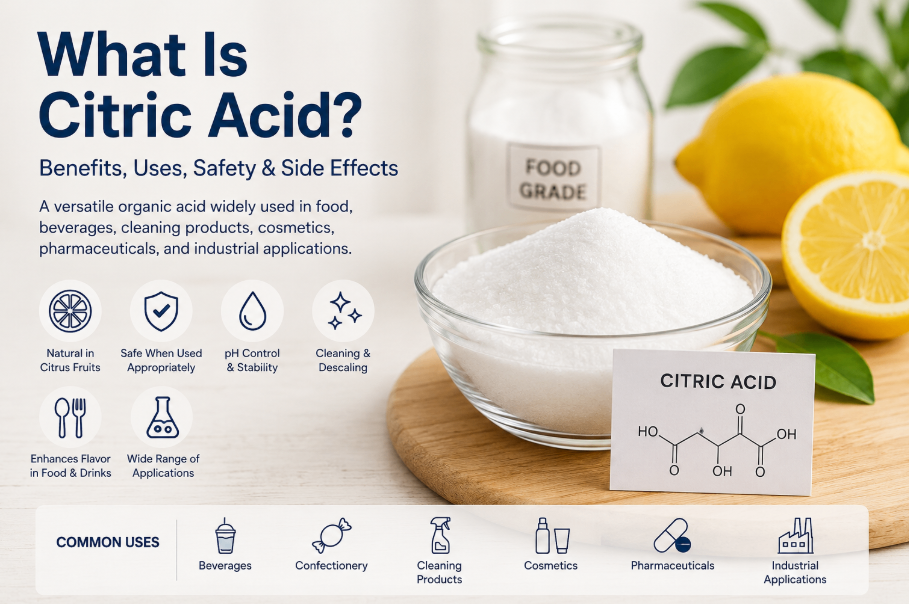
Citric acid is one of the most widely used organic acids in the world. Naturally found in citrus fruits such as lemons, limes, oranges, and grapefruits, it is responsible for their characteristic sour taste. Today, however, most citric acid used in food, beverages, cleaning products, cosmetics, pharmaceuticals, and industrial applications is produced through controlled fermentation.
Because of its versatility, citric acid is valued as an acidulant, preservative aid, chelating agent, pH regulator, flavor enhancer, and cleaning ingredient. It can be found in everything from soft drinks and candies to detergents, water treatment formulations, skincare products, and metal-cleaning solutions.
But what exactly is citric acid, and is it safe? This guide explains the benefits, common uses, safety considerations, and potential side effects of citric acid.
What Is Citric Acid and How Is It Made?
Citric acid is a weak organic acid with the chemical formula C₆H₈O₇. It occurs naturally in many fruits and vegetables, particularly citrus fruits. Lemons and limes are among the best-known natural sources.
Commercially, most citric acid is manufactured through a fermentation process using carbohydrate-based raw materials. During production, microorganisms convert sugars into citric acid, which is then purified, crystallized, and processed into the required form.
Citric acid is commonly available in several forms, including:
Anhydrous citric acid
Citric acid monohydrate
Citric acid powder
Granular citric acid
The two most common commercial forms are anhydrous citric acid and citric acid monohydrate. Anhydrous citric acid contains no crystal water and is often preferred in applications where moisture control is important. Citric acid monohydrate contains one molecule of water of crystallization and is widely used in food, pharmaceutical, and industrial formulations.
Its combination of acidity, water solubility, and chelating properties makes citric acid suitable for a broad range of applications.
What Are the Benefits of Citric Acid?
One of the biggest benefits of citric acid is its multifunctionality. A single ingredient can perform several important roles depending on the application.
Helps Control Acidity and pH
Citric acid is commonly used to reduce and control pH levels. In food and beverages, it provides a refreshing sour taste while helping maintain product consistency. In industrial applications, pH adjustment can also influence chemical stability and process performance.
Supports Product Stability
Citric acid can act as a chelating agent by binding with certain metal ions. This property can help reduce unwanted chemical reactions caused by trace metals.
For manufacturers, this can be useful in formulations where metal ions may affect product quality, color, stability, or performance.
Enhances Flavor
Citric acid is widely used as an acidulant in beverages, candies, jams, sauces, and other food products. Its clean, sharp sour taste makes it especially useful for creating citrus-style flavor profiles.
Useful in Cleaning Formulations
Citric acid is also a popular ingredient in household and industrial cleaning products. It can help remove mineral deposits, soap residue, limescale, and certain types of surface buildup.
For this reason, citric acid is commonly used in:
Bathroom cleaners
Kitchen cleaning products
Descaling agents
Dishwasher cleaners
Water treatment formulations
Its versatility makes it a valuable ingredient for manufacturers developing multipurpose cleaning products.
What Is Citric Acid Used For?
Citric acid has applications across many industries. Its role depends on the product formulation and intended function.
Citric Acid in Food and Beverages
Food and beverage production is one of the largest application areas for citric acid. It is commonly used to provide acidity, enhance flavor, and adjust pH.
Typical applications include:
Soft drinks
Fruit-flavored beverages
Candy and confectionery
Jams and preserves
Sauces
Dairy products
Processed foods
Citric acid may also be used alongside other ingredients to support product quality and shelf stability.
Citric Acid in Cleaning Products
Citric acid is frequently used in cleaning formulations because of its ability to interact with mineral deposits.
It is commonly found in:
Limescale removers
Toilet cleaners
Dishwasher cleaners
Coffee machine descalers
Bathroom cleaning products
General household cleaners
When used in an appropriate formulation, citric acid can help address hard-water deposits and mineral buildup.
Citric Acid in Cosmetics and Personal Care Products
Citric acid is also used in cosmetics and personal care products, primarily as a pH-adjusting ingredient.
It may be included in:
Skincare products
Shampoos
Body washes
Facial cleansers
Hair care products
In cosmetic formulations, maintaining an appropriate pH can be important for product stability, performance, and user experience.
Citric Acid in Pharmaceutical and Industrial Applications
Beyond food and consumer products, citric acid also has pharmaceutical and industrial uses. It may be used in certain formulations as a pH regulator, buffering component, or processing ingredient.
Industrial applications may include:
Water treatment
Metal cleaning
Chemical processing
Detergent manufacturing
Textile processing
The exact grade and specification of citric acid should be selected according to the intended application.
Is Citric Acid Safe?
Citric acid is widely used across food, pharmaceutical, cosmetic, and industrial sectors. However, safety always depends on factors such as product grade, concentration, formulation, exposure level, and intended use.
For example, citric acid used in food products should meet the relevant food-grade requirements. Citric acid used in industrial cleaning products may be handled under very different conditions and concentrations.
As with other acidic substances, concentrated citric acid can cause irritation if it comes into direct contact with sensitive tissues. Proper handling procedures are especially important when working with citric acid powder or concentrated solutions in commercial and industrial environments.
Manufacturers should follow applicable regulations, safety documentation, and formulation requirements for their target markets.
What Are the Possible Side Effects of Citric Acid?
Citric acid is generally well tolerated when used appropriately, but excessive or direct exposure may cause irritation in some situations.
Skin and Eye Irritation
Concentrated citric acid or citric acid solutions may cause irritation if they come into contact with the skin or eyes. The level of irritation can depend on concentration and duration of exposure.
When handling industrial quantities of citric acid powder, appropriate protective equipment may be necessary.
Respiratory Irritation
Fine citric acid powder can create airborne dust during handling. Inhaling large amounts of dust may irritate the nose, throat, or respiratory system.
Industrial users should consider appropriate dust-control and workplace safety procedures.
Dental Concerns
Frequent exposure to highly acidic foods and beverages may contribute to dental enamel erosion over time. This effect is related to repeated acid exposure rather than citric acid alone.
For this reason, beverage and food formulations should be developed with overall acidity and product usage in mind.
Citric Acid Anhydrous vs. Citric Acid Monohydrate: What Is the Difference?
When sourcing citric acid for manufacturing, one important question is whether to choose anhydrous citric acid or citric acid monohydrate.
The main difference is their crystal structure.
Citric acid anhydrous does not contain water of crystallization, while citric acid monohydrate contains one molecule of water.
This difference can affect:
Product weight calculations
Storage requirements
Moisture sensitivity
Processing conditions
Formulation specifications
Anhydrous citric acid is often selected for applications where low moisture content is important. Citric acid monohydrate may be suitable for many food, beverage, pharmaceutical, and industrial applications.
The right choice depends on the specific formulation, processing method, and technical requirements.
Why Is Citric Acid Important for Modern Manufacturing?
Citric acid is more than simply the ingredient that gives lemons their sour taste. It has become an essential raw material across multiple industries because it can perform several functions within a single formulation.
For manufacturers, this versatility can simplify ingredient selection while supporting product performance.
Whether it is used to adjust pH in a beverage, remove mineral deposits in a cleaning product, support formulation stability, or provide acidity in food production, citric acid remains a highly adaptable ingredient.
As global demand for multifunctional and efficient formulation ingredients continues to grow, reliable sourcing and consistent product quality are becoming increasingly important.
Final Thoughts
Citric acid is a versatile organic acid with applications across food, beverages, cleaning products, cosmetics, pharmaceuticals, water treatment, and industrial manufacturing.
Its key benefits include pH control, acidity adjustment, flavor enhancement, chelation, and cleaning performance. While citric acid is widely used, the correct grade, concentration, and handling procedures should always be selected based on the intended application.
For businesses sourcing citric acid anhydrous, citric acid monohydrate, or citric acid powder, factors such as purity, particle size, packaging, storage conditions, and application requirements should all be considered.
With the right specification and quality control, citric acid can serve as a reliable and multifunctional ingredient for a wide range of commercial and industrial products.
FAQs About Citric Acid
What is citric acid mainly used for?
Citric acid is mainly used as an acidulant, pH regulator, flavor enhancer, chelating agent, and cleaning ingredient. It is widely used in food, beverages, cleaning products, cosmetics, pharmaceuticals, and industrial applications.
Is citric acid natural or artificial?
Citric acid occurs naturally in citrus fruits. Most commercial citric acid is produced through a controlled fermentation process using carbohydrate-based raw materials.
Is citric acid safe for food?
Citric acid is widely used in food and beverage manufacturing. However, manufacturers should select the appropriate food-grade specification and comply with relevant regulations and quality requirements.
What is the difference between citric acid anhydrous and monohydrate?
Citric acid anhydrous contains no water of crystallization, while citric acid monohydrate contains one molecule of water. The best choice depends on the intended application and formulation requirements.
Can citric acid be used for cleaning?
Yes. Citric acid is commonly used in descaling and cleaning formulations because it can help remove mineral deposits, limescale, and other types of buildup.